Overview
The ionosphere — Earth’s partially ionized upper atmosphere from roughly 80 to 1000 km — is shaped by a rich interplay of electromagnetic forcing, collisional chemistry, and plasma instabilities. It is simultaneously a practical medium for communications, GPS, and over-the-horizon radar, and an extraordinary natural plasma physics laboratory. When electric fields accelerate electrons across magnetic field lines in the E region (90–150 km), the resulting current-driven instabilities generate plasma turbulence that has fascinated and challenged theorists since the 1960s.
Our group attacks these problems from multiple directions. We run massively parallel particle-in-cell (PIC), hybrid, and multi-fluid simulations that resolve kinetic physics inaccessible to fluid models. Senior Research Scientist Yakov Dimant leads much of the analytic theory in the group, providing essential physical insight alongside the simulations. We compare our results directly to data from incoherent scatter radar (ISR) systems including Millstone Hill, PFISR, and the Jicamarca Observatory.
★ Recent Highlight (2025–2026)
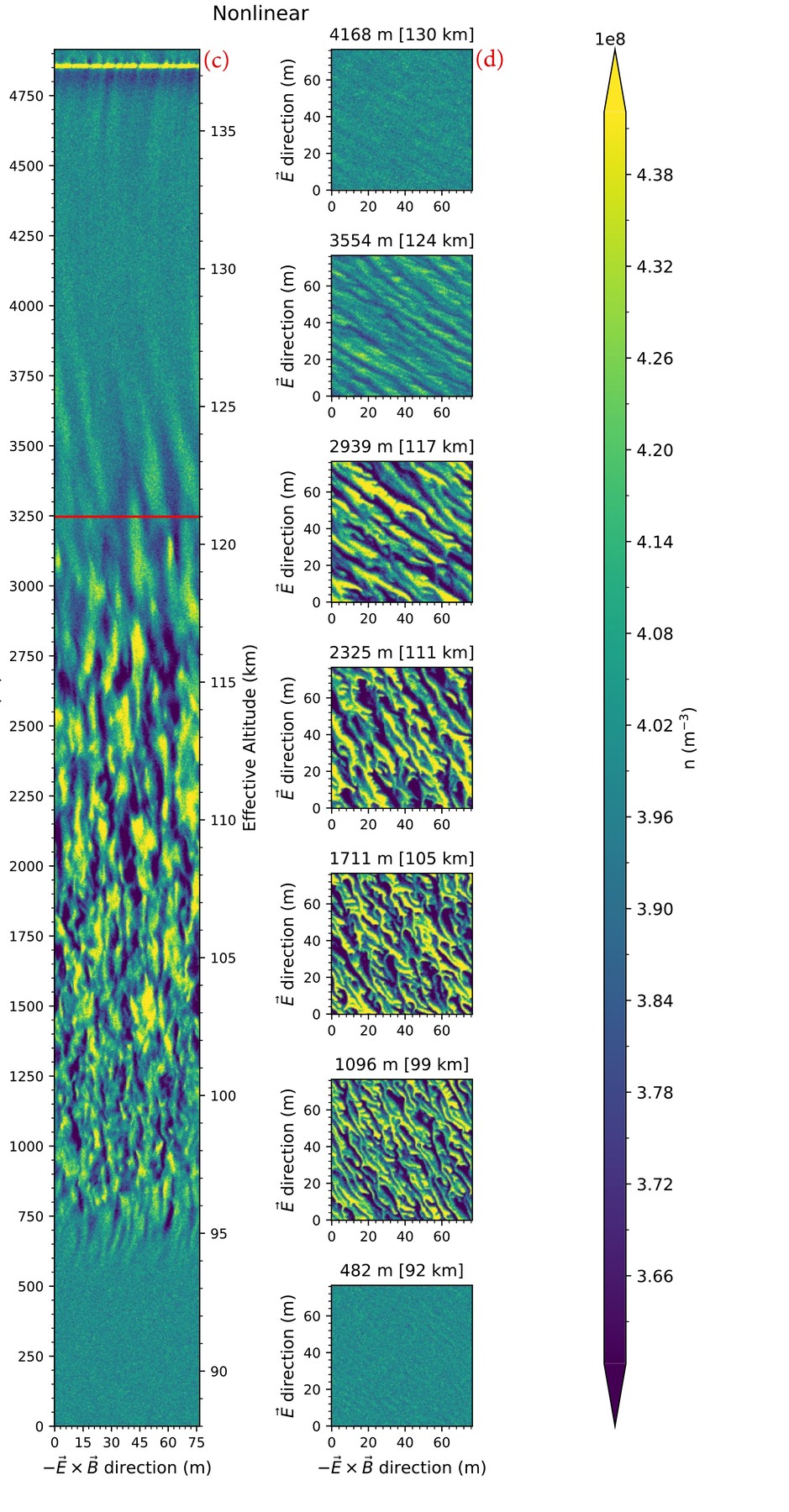
We recently completed the first fully kinetic 3D simulations of the high-latitude electrojet spanning an entire turbulent flux tube through the E region — a landmark computation that was previously out of reach. These simulations reveal how turbulence couples across altitudes and modifies global magnetosphere–ionosphere dynamics (Oppenheim, Dimant, Koontaweepunya, Green, Evans, GRL 2026).
Research Topics
Farley–Buneman Instability and E-Region Turbulence
In the equatorial and high-latitude E region, strong convective electric fields drive the Farley–Buneman (FB) instability, producing field-aligned density irregularities and powerful coherent radar echoes. The nonlinear saturation and anomalous heating produced by FB turbulence remain active research questions. Our PIC and hybrid simulations directly resolve the kinetic wave–particle dynamics that determine the turbulent spectrum and electron temperature enhancement, with direct implications for ionospheric conductivities and global storm dynamics.
Anomalous Conductivities and Global Coupling
Small-scale electrojet turbulence alters the macroscopic conductivity of the ionosphere, which in turn affects the global magnetosphere–ionosphere-thermosphere (MIT) system. We have shown that turbulence-induced anomalous conductivities influence how energy flows during geomagnetic storms and substorms. Our work has been incorporated into global MIT models such as TIEGCM and LFM, directly connecting our microphysics results to space weather prediction.
The Enigmatic 150 km Echoes
Coherent radar echoes appearing near 150 km altitude in the daytime equatorial ionosphere have puzzled researchers for decades — they occur at altitudes where standard instability theory predicts no turbulence. In a 2016 GRL paper highlighted in Science magazine, we proposed and simulated a new mechanism: photoelectron-driven upper hybrid waves. Subsequent work by Longley et al. (2020) and Green et al. (2023) has refined and extended this theory, and Longley’s sole-authored 2024 GRL paper identified nonlinear wave-mode coupling as a further generation mechanism — making the 150 km echo problem one of our group’s most cited contributions.
SAID, STEVE, and Auroral Features
In collaboration with Prof. Joshua Semeter of BU Electrical & Computer Engineering (Prof. Oppenheim also holds a joint appointment in BU Electrical & Computer Engineering), our group studies sub-auroral ion drifts (SAID) and the recently discovered STEVE (Strong Thermal Emission Velocity Enhancement) optical phenomenon, both shaped by sub-auroral electric fields and E-region plasma turbulence.
ISR Spectrum Simulations and Radar Diagnostics
Incoherent scatter radar spectral measurements reveal electron and ion temperatures and drift velocities with great precision — but only if the spectral theory is correct. Our group has developed PIC-based simulations of ISR spectra that include electron–ion Coulomb collisions, electron-electron collisions, and beam–plasma effects (Longley et al. 2018; Díaz et al. 2011). These simulations expose systematic biases in standard ISR temperature retrievals and improve the accuracy of ionospheric diagnostics worldwide.
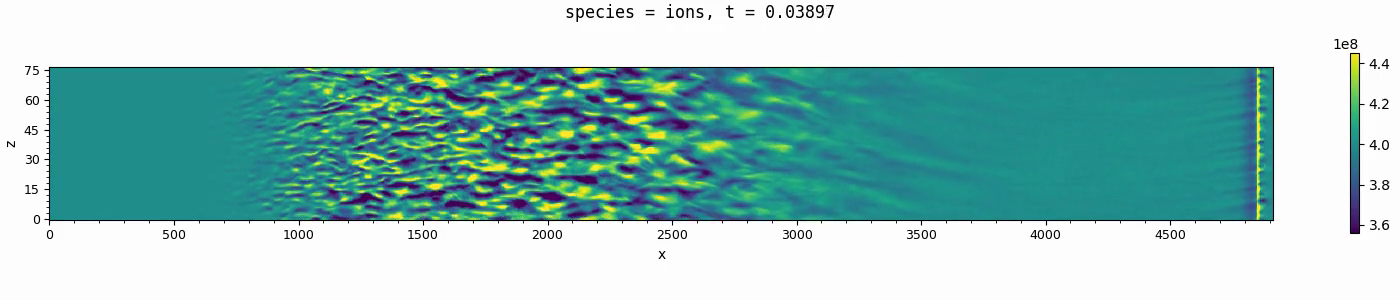
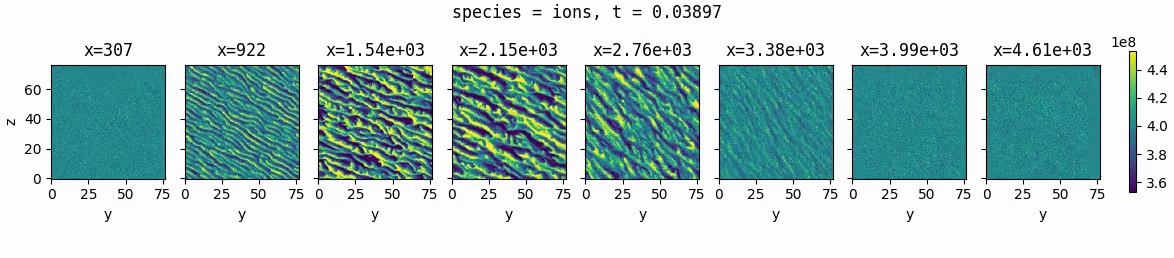
Movies from our latest 3-D kinetic simulation of high-latitude Farley–Buneman turbulence (Oppenheim, Dimant, Koontaweepunya, Green & Evans, GRL 2026). Top: ion density in a vertical plane spanning the electrojet, showing where the turbulence grows across altitude. Bottom: ion density in horizontal planes at a sequence of altitudes — quiescent below, fully turbulent through the mid-electrojet. Click either movie to play.
Selected Recent Publications
- First kinetic 3-D simulations of the high-latitude electrojet spanning an entire turbulent flux tube
Oppenheim, M., Dimant, Y., Koontaweepunya, R., Green, A.Q., Evans, S.; Geophys. Res. Lett., doi:10.1029/2025GL121042, 2026 - Non-Maxwellian ion distribution in the equatorial and auroral electrojets
Koontaweepunya, R.; Dimant, Y.; Oppenheim, M.; Front. Astron. Space Sci., doi:10.3389/fspas.2024.1478536, 2024 - Impact of E-region plasma turbulence on formation and evolution of SAID/STEVE
Pena, J.D.; Semeter, J.; Zettergren, D.; Nishimura, Y.; Hirsch, M.; Oppenheim, M.; Dimant, Y.; Walsh, B.; J. Geophys. Res.: Space Phys., doi:10.1029/2025JA033808, 2025 - An Open Source Code for Modeling Radio Wave Propagation in Earth’s Ionosphere
Green, A., Longley, W., Oppenheim, M., Young, M.; Front. Astron. Space Sci., doi:10.3389/fspas.2025.1521497, 2025 - The Photoelectron-Driven Upper Hybrid Instability as the Cause of 150-km Echoes
Longley, W.J.; Oppenheim, M.M.; Pedatella, N.M.; Dimant, Y.S.; Geophys. Res. Lett., V.47, doi:10.1029/2020GL087391, 2020 - The Generation of 150-km Echoes Through Nonlinear Wave Mode Coupling
Longley, W.J.; Geophys. Res. Lett., V.51, doi:10.1029/2023GL107212, 2024 - ISR Spectra Simulations With Electron-Ion Coulomb Collisions
Longley, W.J.; Oppenheim, M.M.; Fletcher, A.C.; Dimant, Y.S.; J. Geophys. Res.: Space Phys., V.123, pp.2990–3004, doi:10.1002/2017JA025015, 2018 - Particle-in-Cell Simulation of Incoherent Scatter Radar Spectral Distortions Related to Beam-Plasma Interactions in the Auroral Ionosphere
Díaz, M.; Oppenheim, M.; Semeter, J.; Zettergren, M.; J. Geophys. Res., V.116, doi:10.1029/2010JA016096, 2011 - The Farley-Buneman Spectrum in 2-D and 3-D Particle-in-Cell Simulations
Young, M.A., Oppenheim, M.M., Dimant, Y.S.; J. Geophys. Res., 125(1), doi:10.1029/2019ja027326, 2020 - Effects of electrojet turbulence on a magnetosphere-ionosphere simulation of a geomagnetic storm
Wiltberger, M.; Merkin, V.; Zhang, B. et al. including Oppenheim, M.; Dimant, Y.; J. Geophys. Res., doi:10.1002/2016JA023700, 2017 - Photoelectron Induced Waves: A Likely Source of 150-km Radar Echoes and Enhanced Electron Modes
Oppenheim, M., Dimant, Y.S.; Geophys. Res. Lett., V.43, pp.3637–3644, doi:10.1002/2016GL068179, 2016 [Reported in Science]
Ionospheric Research
Ionospheric physics connects fundamental plasma physics to space weather, GPS accuracy, and global climate — a field with both deep scientific questions and practical relevance, spanning kinetic simulation, radar data analysis, and plasma theory.
Research in the group runs through the BU Astronomy PhD program: bu.edu/astronomy/graduate.